Aluminum Can Prices: How Scrap Can Value Works
Aluminum can prices come up any time someone notices how fast empty cans pile up in the garage. Can you actually get money for them, how much, and is it worth the effort? The honest answer is that scrap can value changes all the time and depends on where you live, how many cans you have, and whether your state has a container deposit law. This guide explains how scrap aluminum can pricing works, what affects the number you see at the scale, how to estimate your own payout, and how to store cans so they do not take over your home while you collect them.
We will not quote a "current price" here, because any number printed in an article goes stale quickly. Instead, you will learn how to find today's local rate and do the math yourself.
How Scrap Aluminum Can Prices Work
Scrap yards and recycling centers buy used beverage cans by weight, usually priced per pound. That price is not set by the yard alone. It follows the wider aluminum market, which moves with industrial demand, energy costs, supply, and global trade conditions. Yards then subtract their own handling, sorting, and transport costs and the margin they need to stay in business. The result is the per-pound price posted at your local yard, and it can change from week to week.
A few things to keep in mind:
- Prices differ by location. Two yards in the same region may pay different rates, and big-city yards often price differently from rural ones.
- Volume matters. Some yards offer better rates for large loads or for commercial sellers.
- Clean material earns more. Cans mixed with trash, liquid, steel cans, or plastic may be graded lower or refused.
- The market moves. A price you saw last month may not be the price today, so call ahead or check the yard's website.
How Many Aluminum Cans Are in a Pound?
This is the number that turns a per-pound price into something meaningful. A standard empty 12 oz aluminum beverage can weighs roughly half an ounce, so a commonly cited estimate is about 30 to 35 empty cans per pound. The exact count depends on can size and design: tall 16 oz cans and 24 oz cans weigh more, while slim cans weigh less. Any liquid left inside adds weight that the yard will not pay you for, and many yards will reject wet loads.
If you want a precise figure for your own cans, weigh a bag of a known count on a bathroom or luggage scale and divide.
How to Estimate Your Payout
Once you know your local rate, the math is simple:
- Call or check the website of a nearby scrap yard or recycling center and ask what it pays per pound for aluminum cans (sometimes listed as "UBC," short for used beverage cans).
- Estimate your weight: number of cans divided by about 30 to 35, or weigh the bags directly.
- Multiply the pounds by the per-pound price.
Here is a purely hypothetical example to show the method, not a real price: if a yard paid $0.50 per pound and you brought 10 pounds of cans (roughly 300 to 350 cans), you would receive about $5. Plug in your yard's actual rate to see what your cans are worth today. For most households, scrap can money is a small bonus rather than an income stream, but it adds up for bars, offices, parties, and big families.
Scrap Value vs. Bottle Deposits
Several U.S. states have container deposit laws, often called bottle bills. In those states, eligible cans carry a fixed refund value printed on the label, which you get back at a redemption center, a store, or a reverse vending machine. That refund is separate from scrap value and, for most people, worth more per can than selling by the pound.
The catch: many redemption machines need to scan the barcode and read the can's shape, so crushed cans are often refused for deposit refunds. If you live in a deposit state and plan to redeem, keep those cans whole. Crush only cans you are taking to a scrap yard or putting in curbside recycling, and confirm your local rules first. Our article on whether you should crush cans before recycling goes deeper into when flattening helps and when it gets in the way.
Does Crushing Cans Change the Price?
Crushing does not change the weight of a can, so it does not change what a yard pays per pound. What it changes is volume. Loose, uncrushed cans are mostly air. Flattened cans take up a fraction of the space, which means:
- You can store far more cans between trips to the yard.
- Fewer bags fit in your car for the same weight, saving trips.
- Your garage, kitchen, or pantry stays usable while you collect.
Most scrap yards accept crushed aluminum cans, and some prefer them. A few may ask for cans loose or bagged a certain way, so it is worth asking when you call about the price.
How to Prepare Cans for the Scrap Yard
- Empty and drain them. Leftover soda or beer adds weight you will not be paid for, attracts insects, and can get a load refused.
- Keep them separate. Aluminum only. Steel food cans, plastic bottles, and glass go elsewhere. A magnet helps: aluminum does not stick to a magnet, while steel does.
- Skip the trash. No cups, straws, or food waste in the bags.
- Crush if allowed. Flatten non-deposit cans to save space.
- Bag them in clear bags if your yard allows it, so staff can see the contents quickly.
A Simple Collection Setup
The easiest way to collect cans for scrap is to make crushing faster than tossing a can in the trash. Mount a crusher on a solid wall in the garage, kitchen, or utility room, and put a bin or large bag right below it. Every empty gets one pull of the handle and drops into the bin.
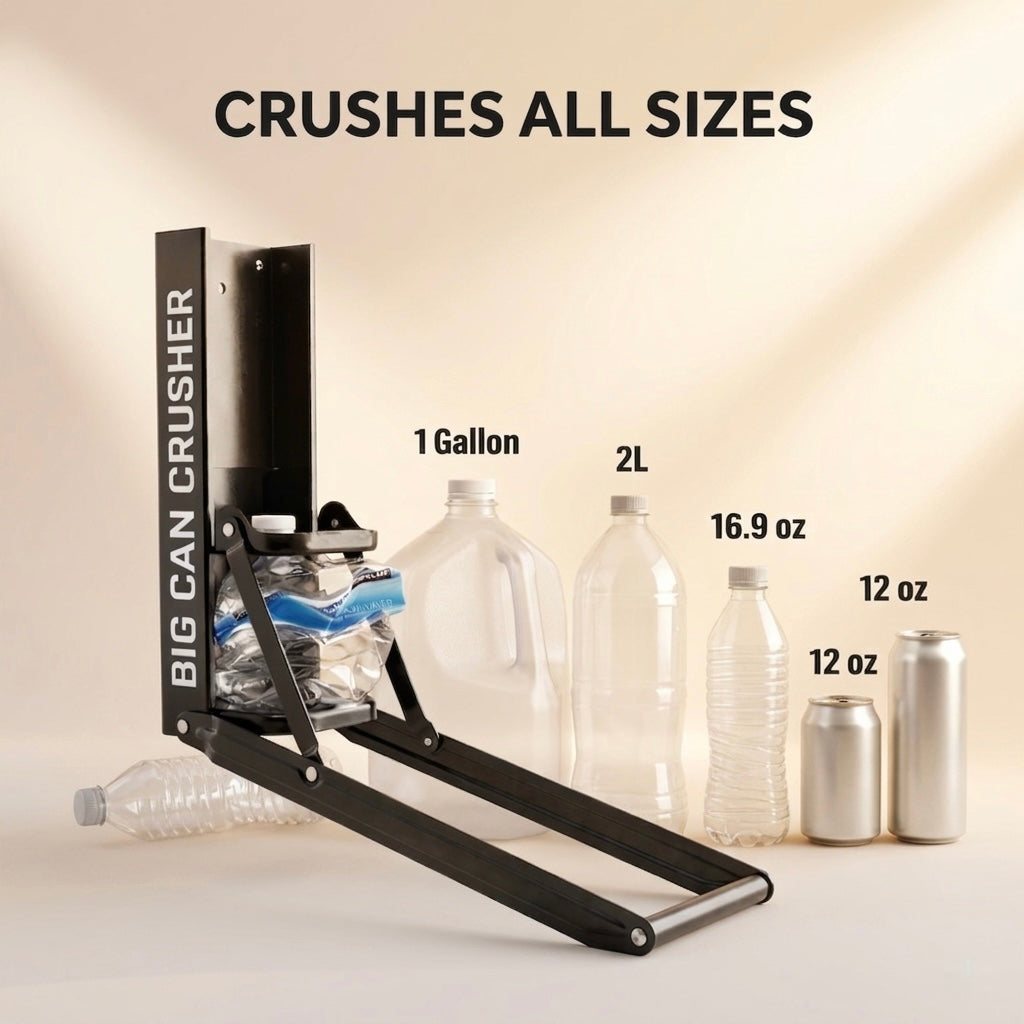
BIG CAN CRUSHER is an all-metal, wall-mounted crusher that flattens 12 oz aluminum cans in a single pull. Its chamber is sized for 1-gallon jugs, so the same tool also crushes 2-liter bottles, 16.9 oz water bottles, and gallon milk and water jugs for your curbside bin. That way one station handles both the cans you sell for scrap and the bulky plastics that fill a recycling bin fastest. Setup details are on the product page, and our guide on how to cut your household recycling volume has more space-saving ideas.
Is Collecting Cans for Scrap Worth It?
It depends on how many cans you go through and how far the nearest yard is. For a single household, the payout is usually modest, and the bigger benefits are a cleaner garage and fewer trips to the curb. For businesses, event hosts, and large households, the cans add up faster and the trip becomes more worthwhile. Either way, aluminum is valuable to recyclers, which is exactly why yards pay for it, and keeping cans out of the trash is worthwhile whether you sell them or put them in curbside recycling.
Practical Takeaway
Scrap aluminum can prices are set per pound, follow the aluminum market, and vary by yard and by week. Expect roughly 30 to 35 empty 12 oz cans per pound, call your local yard for today's rate, and multiply. In deposit states, keep redeemable cans whole because the refund is usually worth more. For everything else, drain the cans, keep aluminum separate, and crush them to save space while you collect.
FAQ
How much are aluminum cans worth?
Scrap yards pay by the pound, and the rate changes with the aluminum market and varies by location. Call a nearby scrap yard or recycling center for the current local price.
How many aluminum cans make a pound?
A commonly cited estimate is about 30 to 35 empty 12 oz cans per pound. Larger cans weigh more per can, so you need fewer of them.
Do scrap yards pay more for crushed cans?
No. Yards pay by weight, and crushing does not change weight. Crushing saves storage space and trips, and most yards accept crushed cans, but ask your yard about its preferences.
Should I crush cans in a bottle deposit state?
Not the ones you plan to redeem. Many redemption machines need to read the barcode and shape of the can and may refuse crushed containers. Crush only cans headed for scrap or curbside recycling.
Can BIG CAN CRUSHER crush aluminum cans and bigger containers?
Yes. It flattens 12 oz aluminum cans and, because its chamber is sized for 1-gallon jugs, it also crushes 2-liter bottles, 16.9 oz water bottles, and gallon jugs. Do not put glass, aerosol cans, or full containers in it. See the product page and our FAQ page for details.
Crush gallon jugs, 2-liter bottles & cans in one pull
See the BIG CAN CRUSHER